Table of Contents
- Bootstrapping: Building Without Outside Investment
- Angel Investors: Early Capital from Experienced Entrepreneurs
- Venture Capital: Growth Capital for High-Potential Startups
- How to Choose the Right Funding Path for Your Business
- Common Fundraising Mistakes and How to Avoid Them
- How to Prepare a Pitch Deck That Gets You Funded
- Frequently Asked Questions
- Your Next Step
- Related Articles
Key Takeaways
- Bootstrapping gives you full control but limits growth speed and requires profitability from day one
- Angel investors provide early capital and mentorship in exchange for equity typically 5-20% of your company
- Venture capital is suited for high-growth startups targeting large markets with the potential for 10x returns
- The best funding path depends on your business model, market size, and personal goals
- Most successful startups combine multiple funding sources at different stages of growth
Bootstrapping: Building Without Outside Investment
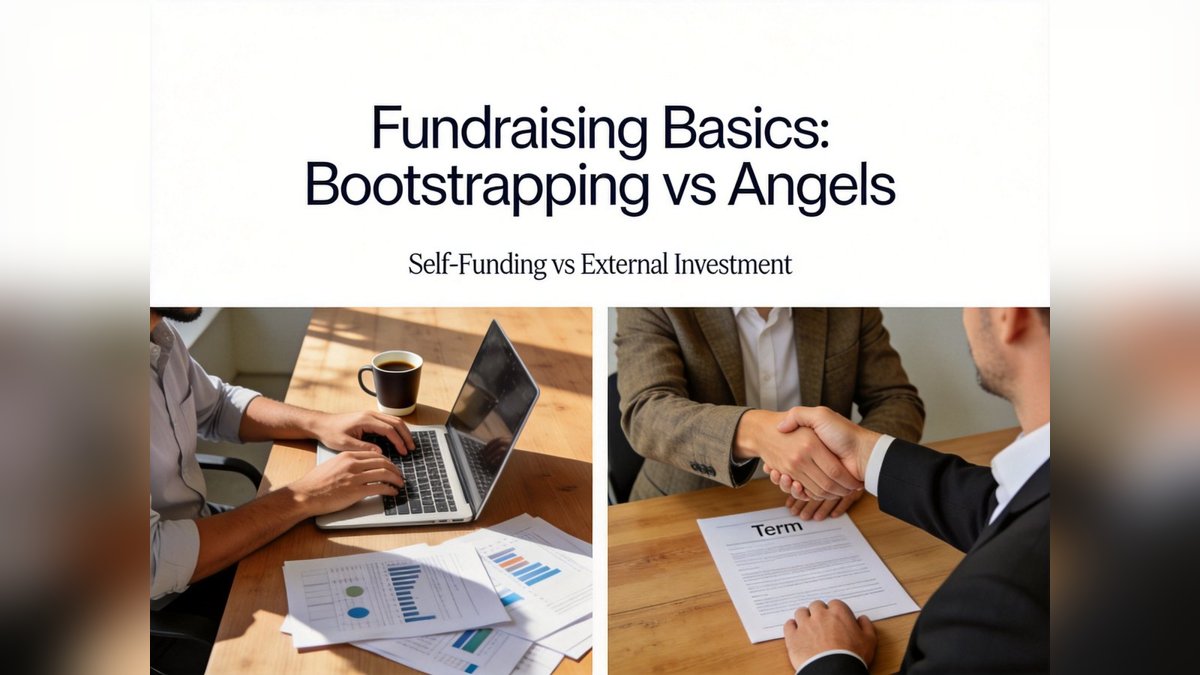
Bootstrapping means funding your startup entirely through your own savings and the revenue you generate. It is the purest form of entrepreneurship: you build a business that sustains itself from day one. This approach gives you complete control over every decision. There are no investors to answer to, no board meetings to prepare for, and no pressure to grow at any cost.
"The best time to raise money is when you do not need it. Investors are attracted to momentum, not desperation. Build traction first, then raise capital to accelerate what is already working. The strongest negotiating position is a business that can survive without the investment."
The trade-off is significant. Without outside capital, your growth is limited by your revenue. You cannot spend heavily on marketing, hire a large team, or invest in expensive infrastructure before you have the money to pay for it. Bootstrapped businesses grow slower, but they grow on their own terms.
Many of the most successful companies started as bootstrapped businesses. Mailchimp, Basecamp, and GitHub all bootstrapped for years before taking outside investment or achieving massive exits. The key to successful bootstrapping is choosing a business model that generates cash quickly. Service businesses, software with short sales cycles, and products with high margins are all well-suited to bootstrapping.
Angel Investors: Early Capital from Experienced Entrepreneurs
Angel investors are typically wealthy individuals who invest their own money in early-stage startups. They often have entrepreneurial backgrounds themselves and bring more than just money to the table. Angel investors provide mentorship, industry connections, and strategic advice that can be as valuable as their capital.
Angel investments typically range from $25,000 to $150,000, though syndicates and angel groups can pool resources for larger rounds. In exchange, angels usually receive 5-20% equity in your company. The valuation at the angel stage is often based on your team, traction, and market opportunity rather than detailed financial projections.
Finding the right angel investor is about more than the check size. Look for investors who understand your industry, have a network that can open doors, and are aligned with your vision for the company. The best angel investors are those who have built companies themselves and can help you navigate the challenges of early-stage growth. A bad angel investor brings stress and misaligned expectations. Choose carefully.
Venture Capital: Growth Capital for High-Potential Startups
Venture capital firms invest other people's money (typically from institutions like pension funds and endowments) into high-growth startups. VC is not suitable for every business. Venture capitalists look for companies that can return 10x or more on their investment within 5-10 years. This means they target large markets, strong founding teams, and defensible business models.
The venture capital process is rigorous. Firms typically review hundreds of opportunities for every one they invest in. The process includes initial meetings, due diligence (market analysis, financial review, customer interviews), term sheet negotiation, and legal documentation. The entire process from first meeting to funded can take 2-6 months.
VC funding comes with strings attached. Investors typically take board seats, have veto rights over major decisions, and expect a liquidity event (acquisition or IPO) within a defined timeframe. Your control over the company diminishes with each funding round. For the right business in a large market, VC funding can accelerate growth dramatically and create enormous value.
How to Choose the Right Funding Path for Your Business
The right funding path depends on three factors: your market size, your business model, and your personal goals. If you are building a lifestyle business or serving a niche market, bootstrapping is likely the best path. You can build a profitable, sustainable business without the pressure of investor expectations.
If you are targeting a large market with a business model that requires significant upfront investment (hardware, biotech, capital-intensive SaaS), venture capital may be necessary. Some businesses simply cannot be built without substantial capital. In these cases, taking VC funding is not a choice but a requirement.
Angel investment sits in the middle. It is appropriate when you need moderate capital to reach a milestone that will increase your valuation before a larger VC round. Many startups use angel funding to build their MVP, acquire their first customers, and prove product-market fit before raising a larger institutional round.
Common Fundraising Mistakes and How to Avoid Them
The most common fundraising mistake is raising money too early. Without traction, you will get unfavorable terms and dilute your equity unnecessarily. Wait until you have evidence that your business model works before seeking outside investment.
Another common mistake is raising from the wrong investors. Not all money is good money. Investors who do not understand your industry, have conflicting portfolio companies, or push for strategies that do not align with your vision can cause more harm than good. Due diligence works both ways. Talk to other founders in their portfolio before accepting a check.
Finally, avoid raising more money than you need. Extra capital in the bank can lead to sloppy spending and loss of focus. Raise enough to reach your next clear milestone and no more. The discipline of capital constraints forces you to make efficient decisions.
How to Prepare a Pitch Deck That Gets You Funded
Your pitch deck is often the first impression investors have of your company. A great pitch deck tells a clear story: what problem you are solving, why it matters, why your solution is unique, and why your team is the right one to execute. The most effective decks are 10-12 slides and take no more than 10 minutes to present. Investors see hundreds of decks every month. Yours needs to stand out within the first 30 seconds.
The key slides in any pitch deck are: problem, solution, market size, business model, traction, team, and ask. The problem slide should make the investor feel the pain of your target customer. The solution slide should show how your product alleviates that pain in a unique way. The market size slide should demonstrate that the opportunity is large enough to support a venture-backed business. Investors need to see a clear path to a billion-dollar market.
Practice your pitch relentlessly. The first time you present your deck should never be to an actual investor. Present to friends, mentors, and other founders first. Record yourself and watch it back. Every slide should be clear enough that someone who knows nothing about your industry can understand it. If you have to explain a slide, the slide is not working.
Frequently Asked Questions
Common questions about this topic
What percentage of my company should I give to an angel investor?
Typical angel investments range from 5% to 20% depending on the amount raised and your valuation. The exact percentage is less important than whether the investor adds strategic value beyond their check.
Can I bootstrap and still grow fast?
Yes, but growth will be slower than with outside capital. Focus on high-margin products, word-of-mouth marketing, and revenue-generating activities. Some of the most successful companies grew to significant scale without VC funding.
How do I find angel investors?
Start with your network. Attend industry events, join startup accelerators, and use platforms like AngelList. Warm introductions through mutual connections are far more effective than cold outreach.
What if no investor wants to fund my startup?
That may be a signal that your business model or market needs adjustment. Consider bootstrapping or adjusting your approach. Many successful companies were initially rejected by every investor they approached.
Related Articles
Your Next Step
The information in this guide is designed to give you a practical starting point for your career journey. Apply the strategies that resonate most with your situation and adapt them to your specific context. The most successful professionals are not the ones who follow every piece of advice they are the ones who know which advice applies to their unique circumstances.
If this article helped you, explore our related resources linked below to continue building your career toolkit. Each article builds on the same practical, evidence-based approach to career development.