Table of Contents
- Why Setting Boundaries at Work Feels So Hard
- Assessing Your Current Boundaries and Where They Are Weak
- How to Communicate Boundaries Professionally
- Setting Boundaries with Managers and Senior Leaders
- Handling Pushback and Maintaining Boundaries Long-Term
- Frequently Asked Questions
- Your Next Step
- Related Articles
Key Takeaways
- Boundary setting is difficult because of fears about career consequences and the psychological fusion between self-worth and productivity
- Assess boundary gaps in four areas: working hours, scope of work, emotional boundaries, and physical workspace
- Use the when-then structure and positive no technique to communicate boundaries factually and professionally
- Frame boundaries with managers in terms of outcomes and quality rather than personal limitations
- Expect pushback when first setting boundaries, maintain consistency, and periodically review boundaries as circumstances change
Why Setting Boundaries at Work Feels So Hard
Setting boundaries at work is difficult for most professionals because it triggers deep-seated concerns about career consequences. The fear of being seen as not a team player, of missing out on opportunities, of being passed over for promotion, or of damaging important relationships creates powerful resistance to boundary-setting. These fears are not unfounded; in many workplaces, pushing back against demands can have real consequences. However, the cost of not setting boundaries is often higher than the perceived risk of setting them.
The root of boundary-setting difficulty often lies in how professionals define their self-worth. When your identity is closely tied to your work performance and your value is measured by what you produce, saying no to work feels like saying no to yourself. This psychological fusion between self-worth and productivity creates a powerful drive to never refuse a request. The first step in effective boundary-setting is separating your value as a person from your output as a professional.
oundaries are not walls. They are gates that you control. A wall keeps everything out and isolates you. A gate lets the right things in and keeps the wrong things out. The goal of boundary-setting is not to become difficult or uncooperative. It is to ensure that when you say yes, it means something because you have the ability to say no.
Assessing Your Current Boundaries and Where They Are Weak
Before setting new boundaries, take stock of your current situation. Identify the areas where you feel most stretched, resentful, or overwhelmed. Common boundary gaps include working hours: checking email late at night, responding to messages on weekends, or consistently working past your scheduled end time. Scope of work boundaries: taking on tasks outside your role, covering for underperforming colleagues, or absorbing work that should be distributed across the team.
Emotional boundaries are equally important but less discussed. These involve managing how much of others' stress, anxiety, or crises you absorb. If you find yourself carrying the emotional weight of team conflicts, client dissatisfaction, or management pressures beyond what is appropriate for your role, your emotional boundaries may need reinforcement. Physical boundaries include having a dedicated workspace, protecting your break times, and maintaining control over your calendar.
Rate each boundary area on a scale of one to ten, with ten being completely solid. The areas scoring lowest are your priority targets for improvement. Focus on one or two boundary areas at a time rather than trying to transform everything at once. Gradual, sustainable change is far more effective than dramatic declarations that you cannot maintain.
How to Communicate Boundaries Professionally
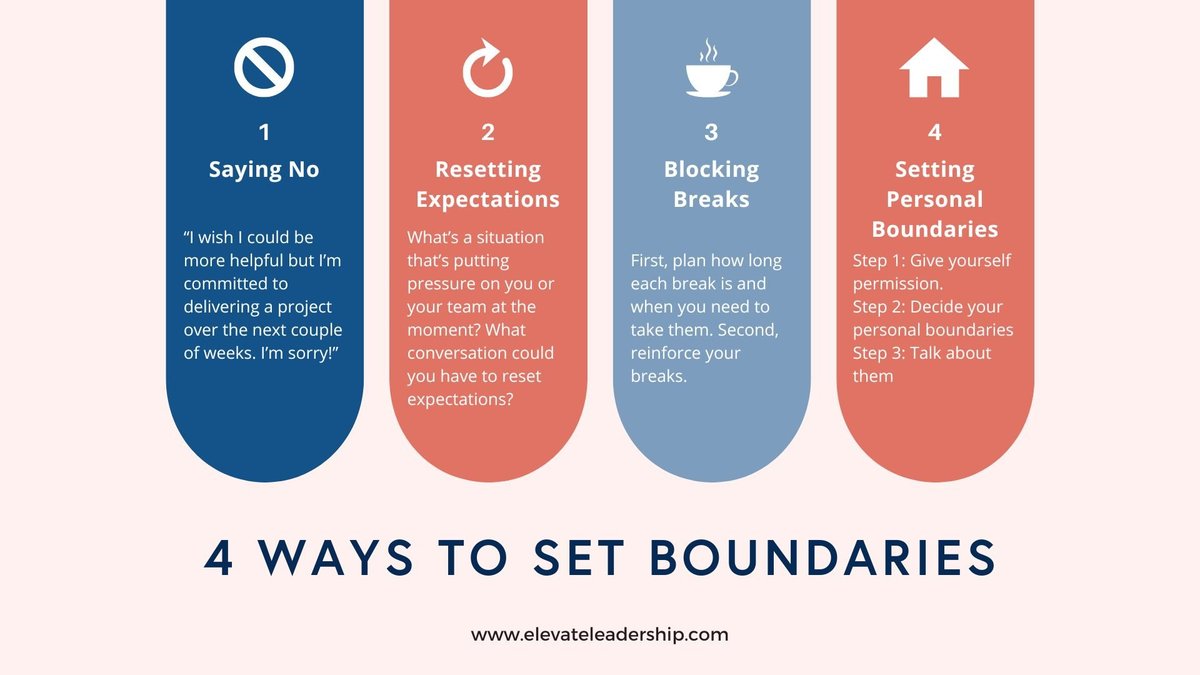
Communicating boundaries effectively requires a specific approach that balances firmness with professionalism. Use the when-then structure: when X happens, then I will Y. For example: When I receive a request after 6 PM, I will respond the next business day. When my workload reaches capacity, I will ask you to help prioritize which tasks take precedence. This structure is factual rather than emotional and makes clear what behavior to expect.
For declining additional work, use the positive no: Express appreciation for the opportunity, clearly state your limitation, and offer an alternative. For example: I appreciate you thinking of me for this project. I cannot take on additional work right now without compromising the quality of my current commitments. Would it help if I suggested a colleague who has capacity, or should we discuss reprioritizing my existing workload?
Practice your boundary language before you need it. The more you rehearse these conversations, the more naturally they will come when you need them. Start with lower-stakes boundaries like meeting times or email response expectations before addressing more challenging issues like workload capacity or role scope. Each successful boundary conversation builds confidence for the next.
Setting Boundaries with Managers and Senior Leaders
Setting boundaries with managers requires strategic communication that aligns your needs with organizational priorities. Frame boundaries in terms of outcomes rather than personal limitations. Instead of I cannot handle more work, say To ensure the quality of our current projects, I need to focus on the existing priorities. Can we discuss which deliverables should take precedence? This reframes the conversation from personal capacity to business outcomes.
When requesting changes to how you work with your manager, come with data. Document your current workload, the time required for each responsibility, and the impact on quality or deadlines. Present this information neutrally and ask for your manager's help in solving the problem. Most managers respond better to collaborative problem-solving than to ultimatums, even when the underlying need is the same.
For recurring boundary issues with managers, such as after-hours messages or last-minute requests, establish clear protocols. Propose a system: I will check messages at 9 AM and 3 PM. For urgent matters, please call my mobile. This structure gives the manager a clear channel for truly urgent issues while protecting you from the expectation of constant availability.
Handling Pushback and Maintaining Boundaries Long-Term
When you first set boundaries, expect some pushback. People who are used to you being always available may resist your new limits. This is normal and does not mean your boundaries are wrong. Respond to pushback calmly and consistently. Do not over-explain or apologize for your boundaries. A simple statement like I understand this is different from before, and I have found that this approach allows me to do my best work is sufficient.
Consistency is the key to maintaining boundaries long-term. A boundary that you enforce sometimes and ignore other times is not a boundary; it is a request. When you make an exception, be intentional about it. Say I am making an exception this time because of the specific circumstances, rather than silently breaking your own rule. This preserves the boundary's validity while allowing appropriate flexibility.
Finally, periodically review your boundaries. As your role, team, and personal circumstances change, your boundaries need adjustment. What worked in one job may not work in another. What was necessary during a period of high personal demands may be relaxed during calmer times. Regular boundary reviews keep your professional life in alignment with your current needs and priorities.
Frequently Asked Questions
Common questions about mental health
Will setting boundaries hurt my career advancement?
Setting boundaries thoughtfully generally does not hurt careers. In fact, professionals who communicate their limits clearly are often respected more, not less. The key is how you communicate them. Boundaries framed around maintaining quality and focus are typically well-received. The risk is not in setting boundaries but in setting them poorly or being consistently unavailable without explanation.
How do I say no to my boss without sounding difficult?
Use the positive no structure: express appreciation, state your limitation clearly, and offer an alternative. For example: I really appreciate you trusting me with this. To maintain quality on my current priorities, I cannot take this on right now. Could we discuss which existing task I should defer to make room, or find another person for this new project?
What if my workplace culture does not support boundaries?
In cultures where overwork is normalized, setting boundaries is harder and more important. Start small with boundaries that are hard to criticize, like taking a full lunch break or leaving on time once a week. Find allies who share your concerns. If the culture is genuinely toxic and boundary-setting is punished rather than accommodated, the long-term solution may be finding a workplace whose values align with yours.
Related Articles
Your Next Step
The information in this guide is designed to give you a practical starting point for your career journey. Apply the strategies that resonate most with your situation and adapt them to your specific context. The most successful professionals are not the ones who follow every piece of advice — they are the ones who know which advice applies to their unique circumstances.
If this article helped you, explore our related resources linked below to continue building your career toolkit. Each article builds on the same practical, evidence-based approach to career development.