Table of Contents
- Understand the Technical Interview Process Before You Start Preparing
- Master Algorithms and Data Structures: The Top 20 Patterns
- Systematic Practice: How to Use LeetCode and Other Platforms Effectively
- System Design Interviews: How to Approach Architecture Questions
- Behavioral and Soft Skills: The Half Most Candidates Neglect
- Your Next Step
Key Takeaways
- Technical interviews follow a predictable pattern: phone screen, coding challenge, and on-site rounds
- Mastering the top 20 most common data structures and algorithm patterns covers over 80% of interview questions
- Systematic practice with spaced repetition is more effective than cramming hundreds of problems without review
- System design interviews test your ability to think at scale, not your knowledge of specific technologies
- Behavioral questions are weighted equally with technical performance at most top companies
Understand the Technical Interview Process Before You Start Preparing
Technical interviews at most companies follow a predictable structure. Understanding this structure allows you to prepare strategically rather than randomly. The typical process includes an initial recruiter screen, a technical phone screen or online assessment, and then a series of on-site or virtual interviews covering coding, system design, and behavioral questions.
The recruiter screen is a conversation about your background, experience, and motivations. Be prepared to articulate why you want the role and what you bring to the team. The technical phone screen typically lasts 45 to 60 minutes and includes one or two coding problems. You will share your screen and write code in a simple editor. Communication during this round matters as much as correctness.
The on-site or virtual final round usually includes three to five interviews. These cover data structures and algorithms, system design for mid-level and senior roles, behavioral questions, and sometimes a take-home project or pair programming exercise. Each round typically lasts 45 to 60 minutes with a different interviewer. Knowing what to expect reduces anxiety and allows you to allocate preparation time effectively.
"The candidates who perform best in technical interviews are not necessarily the best engineers. They are the ones who understand the game and have practiced it deliberately. Technical interviewing is a skill separate from day-to-day engineering, and it requires dedicated preparation."
Master Algorithms and Data Structures: The Top 20 Patterns
At least 80% of coding interview questions fall into about 20 distinct patterns. Mastering these patterns is far more efficient than memorizing hundreds of individual problems. The patterns include two pointers, sliding window, binary search, depth-first search, breadth-first search, dynamic programming, recursion, and graph traversal, among others.
Start with arrays and strings, which are the foundation of most coding problems. Learn the common manipulation techniques: reversing, rotating, searching, and sorting. Then move to hash tables, which are the single most useful data structure for interviews. Hash tables solve a wide range of problems efficiently and are supported in every language.
Linked lists, stacks, and queues follow. These data structures appear less frequently in day-to-day work but are common interview topics. Trees and graphs are next. Binary trees, binary search trees, and graph traversal algorithms like DFS and BFS are essential. Dynamic programming is the most challenging pattern for most candidates. Focus on the classic problems: Fibonacci, knapsack, coin change, and longest common subsequence.
For each pattern, learn the underlying concept, study two or three representative problems, and practice until you can recognize when the pattern applies. The goal is pattern recognition, not problem memorization.
Systematic Practice: How to Use LeetCode and Other Platforms Effectively
LeetCode is the most popular platform for technical interview preparation, but using it effectively requires strategy. Do not solve problems randomly. Follow a structured study plan. Many platforms offer curated lists organized by pattern or difficulty. Use these to build skills progressively rather than jumping to hard problems immediately.
Quality of practice matters far more than quantity. Solving one problem thoroughly, including analyzing time and space complexity and exploring alternative solutions, is worth more than solving five problems superficially. For each problem you attempt, give yourself 30 to 45 minutes to solve it independently. If you cannot solve it in that time, study the solution, understand it completely, and then re-implement it from memory the next day.
Spaced repetition is critical. Review problems you solved one week ago, one month ago, and three months ago. If you cannot solve them again efficiently, you have not truly learned them. Create a system for tracking which patterns you have mastered and which need more work. Many candidates find that maintaining a spreadsheet or using Anki flashcards helps with retention.
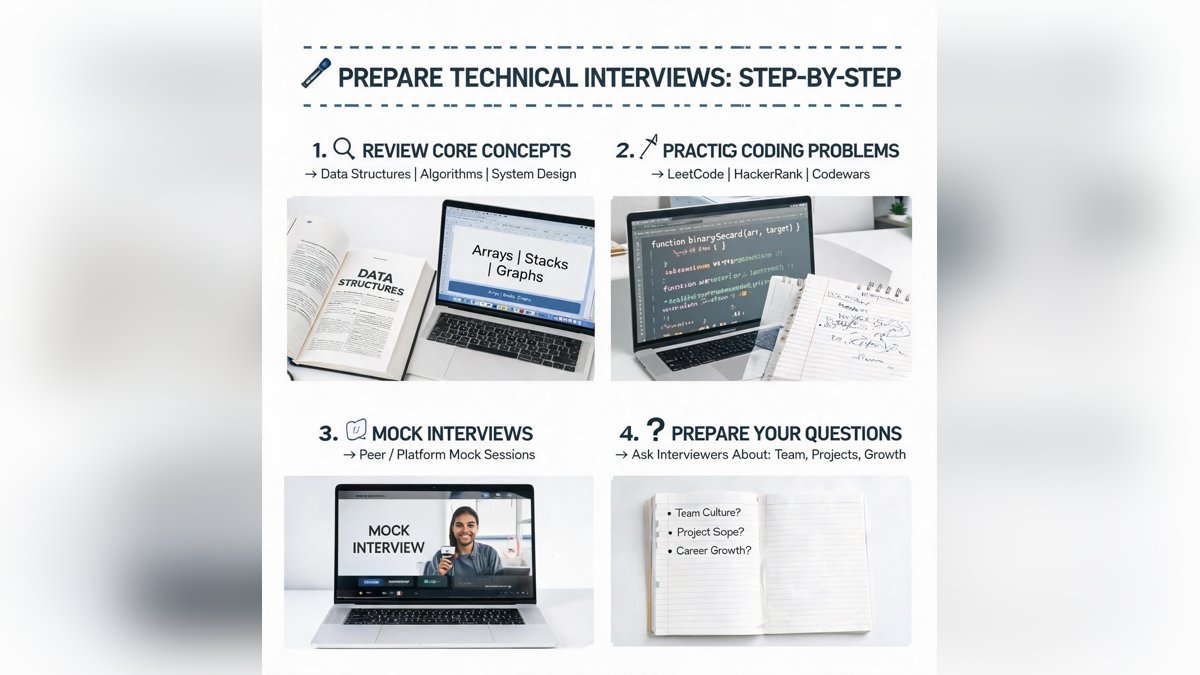
Mock interviews are invaluable. Practice coding while talking through your thought process with another person. Platforms like Pramp, interviewing.io, and Meetapro connect you with peers or professional interviewers for mock sessions. The goal is to build fluency in communicating while coding, which is the skill that most candidates find challenging.
System Design Interviews: How to Approach Architecture Questions
System design interviews become relevant for mid-level and senior engineering roles. These interviews assess your ability to design scalable systems and make sound architectural decisions. The most common topics include designing a URL shortener, a chat system, a social media feed, a web crawler, or a rate limiter.
A structured approach to system design involves four steps. First, clarify requirements. Ask questions to understand the scope, scale, and constraints. Second, establish a high-level design. Outline the major components and how they interact. Third, dive into detailed design for the most critical components. Fourth, identify trade-offs and discuss alternatives.
You are not expected to design a perfect system in 45 minutes. Interviewers want to see your thought process, your ability to make reasonable assumptions, and your awareness of trade-offs. Communicate clearly, acknowledge constraints, and prioritize functionality over perfection.
Behavioral and Soft Skills: The Half Most Candidates Neglect
Behavioral questions carry significant weight in technical interviews. Companies evaluate whether you will be a good teammate, how you handle conflict, and whether you align with company values. The STAR method (Situation, Task, Action, Result) is the standard framework for structuring your answers.
Prepare stories for common behavioral questions: a time you resolved a conflict, a time you failed and what you learned, a time you showed leadership, and a time you went above and beyond. Each story should be specific, genuine, and structured with a clear outcome. Avoid generic answers. Interviewers can tell when you are reciting a prepared script without real experience behind it.
Communication during the interview itself is as important as the content of your answers. Speak clearly, listen actively, and ask clarifying questions. Demonstrating that you are someone the team would enjoy working with is often the deciding factor between two technically qualified candidates.
Related Articles
Your Next Step
The information in this guide is designed to give you a practical starting point for your career journey. Apply the strategies that resonate most with your situation and adapt them to your specific context.
If this article helped you, explore our related resources linked below to continue building your career toolkit.